Oops! Something went wrong while submitting the form.
Start the conversation
Tell us briefly about your organisation and what you're trying to understand. We'll come back to you within one business day.
Thank you! Your submission has been received!
Oops! Something went wrong while submitting the form.
No obligation. No sales pitch on the first call. The conversation starts where your questions are.
Your Facilities Data Isn't Perfect. Start Using It Anyway.
Published on :
July 3, 2026
by
Anisha Bhattacharjee
Views...
You can't tell if the traffic signal up ahead has turned green from where you're parked. You can guess based on how long it's usually been red. You can wait a little longer to be sure. But the only way to actually know is to drive up and look.
With facilities data, the instinct flips. Incomplete BMS readings, half-filled checklists, inconsistent maintenance logs, most teams already know this is what their data looks like day to day. So the instinct is to wait until it's cleaner before actually putting it to work. Centralize it, build a data lake, standardize every schema, clean the historical record. Then, once the data is finally "good enough," start using it.
That approach treats data quality as a gate you pass through once, clear it, and move on. It sits upstream of operations, though, and by design nothing changes for the people doing the work until it's finished.
A work order marked closed with no explanation of what was actually done still looks complete on a dashboard. A maintenance checklist with missing observations sits quietly in the system for months, unquestioned because nobody has gone looking. Neither problem announces itself. Both only become visible when someone actually tries to use that record to make a decision. Standardizing or organizing the record afterward doesn't recover what was never written down. The best chance to catch that gap is the moment the work order is closed, the moment the checklist is filled in, not months later when someone is forced to piece it back together.
That's the important shift. You don't need perfect data to start. You need a process that catches what's wrong, fixes it, and keeps checking so the same problem doesn't quietly return. Good data isn't a starting point, it's an outcome, one that a governance layer builds by making sure poor data doesn't stay hidden for long, and that every operational activity leaves behind a better record than the one before it.
Xempla is that governance layer, sitting above BMS, CMMS and the rest of the FM stack. There's no separate project running in the background, no waiting for a phase to complete before the benefit shows up. Quality gets built into the work as it happens. The following example comes from a live Xempla deployment.
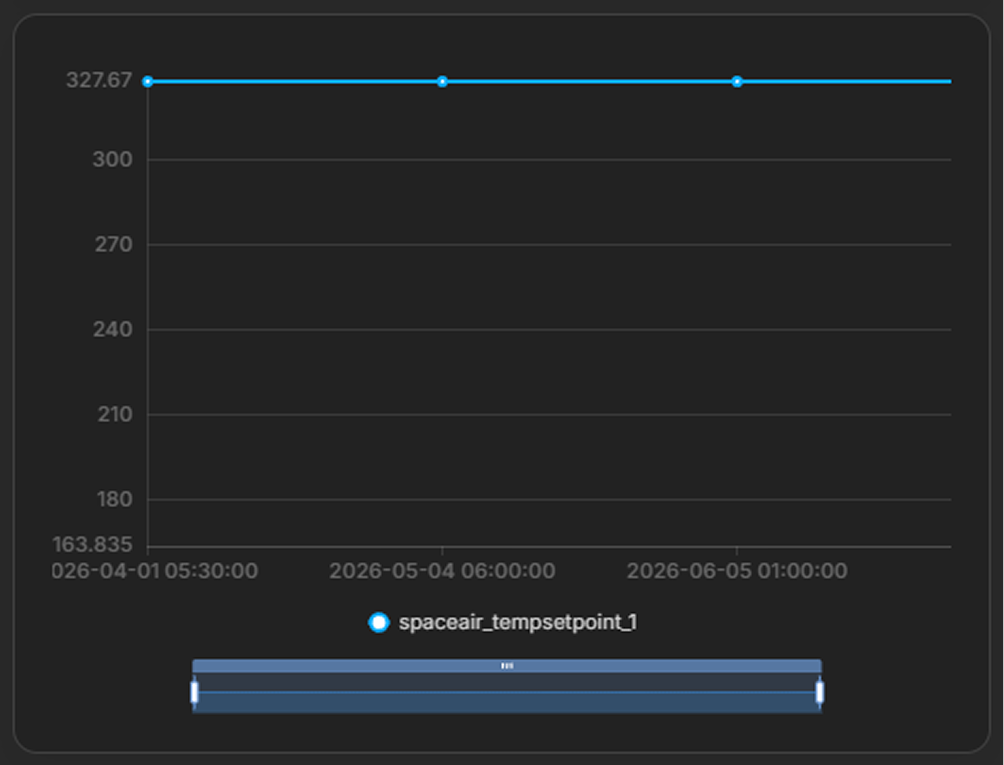
A Building Management System suddenly reported a temperature setpoint of 327.67°C. Clearly, that isn't a real operating condition. At that point, though, it was impossible to know whether the problem lay with the asset itself or with the data being generated.
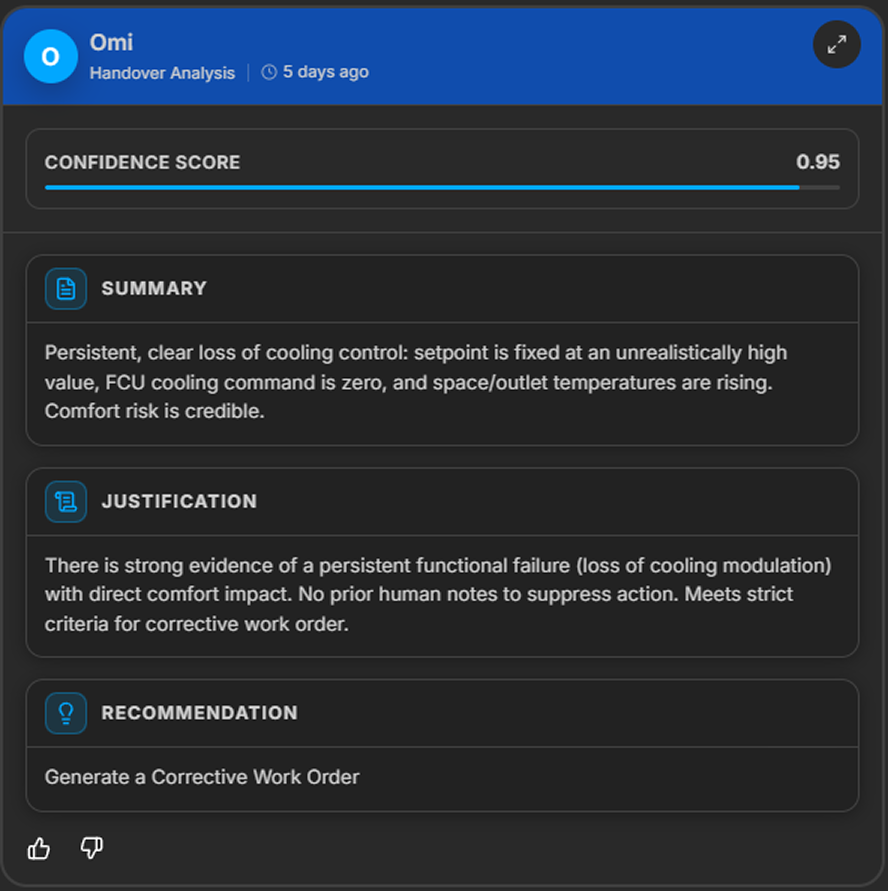
Xempla's Reliability Agent, Omi, detected the abnormal pattern and flagged it for investigation. Rather than assuming an equipment failure, the investigation found that the issue was a faulty control sensor producing invalid readings. A simple sensor restart restored normal operation.
The asset didn't need repairing but the data did.
Bad data becomes visible: An abnormal BMS reading is detected. .
Better data starts here: Omi recommends the next corrective action.
That's how good operational data actually gets built, not through one-time cleanup exercises, but through a continuous process of detecting, validating and correcting what doesn't look right. The same principle extends across both Soft FM and soft FM.
In Soft FM, the traditional process often ends with a completed checklist. It confirms that a supervision round took place, but it rarely captures what was actually observed. Xempla shifts the point of data capture to the moment the work happens. Supervisors record structured observations, supported by photos, voice notes and other evidence as they move through the site. Every observation is automatically checked for completeness, supporting evidence and follow-up actions. Instead of becoming another compliance record, each round becomes a verified operational record that contributes to a richer understanding of service quality over time.
In Hard FM, Xempla applies the same approach through its DIIV cycle: Discover, Investigate, Implement and Verify. At the point of capture, readings, measurements and technician observations are logged directly against the asset, not written up later from memory. Each entry is checked instantly against expected ranges, historical performance and known operating thresholds, so a value that doesn't fit gets noticed the moment it comes in, not weeks later during a review. From there, genuine issues get escalated for action while routine entries move through without adding extra work for anyone. The loop only closes once the outcome has been verified, not simply because someone marked the task complete. It's the same principle that fixed the faulty sensor, an anomaly detected, investigated and resolved, leaving behind a stronger operational record than the one before it.
Every inconsistency that's flagged, every investigation carried out and every corrective action taken is preserved alongside the reasoning behind it. Over time, the record stops being a log of activities and becomes a trail of operational decisions, which is what actually makes the data trustworthy: not simply that something happened, but that the organization understands why it happened and what was done about it.
This idea isn't entirely new. JLL's widely referenced 5Cs of quality asset data, complete, comprehensive, consistent, correct and current, have long defined what good asset inventory data looks like. The same thinking applies here. Every inspection, every maintenance activity and every corrective action is another opportunity to make operational records more complete, more comprehensive, more consistent, more correct and more current than they were the day before.
So perhaps the better question isn't whether your data is good enough. It's whether the way you work is making it better every time work gets done. Because the goal was never getting everything right on day one, it's a system that keeps improving on the day before.
FAQs
Why is data quality important for AI in facilities management?
AI relies on operational data to identify patterns, recommend actions and support better decision-making. If maintenance records, inspections or sensor data are incomplete or inconsistent, AI can only work with the information it receives. The goal isn't perfect data from day one, but an operating model that continuously improves data quality over time.
Should organizations wait until their facilities management data is clean before adopting AI?
Not necessarily. Waiting for perfect data often delays the very process that improves it. As operational teams use data to make decisions, they uncover gaps, correct inconsistencies and create better records. Data quality improves through continuous use and governance, not just one-time cleanup projects.
What does good facilities management data look like?
Good facilities management data is complete, comprehensive, consistent, correct and current. Beyond accurate asset inventories, it should also capture operational context, such as inspection findings, maintenance decisions, supporting evidence and the reasoning behind corrective actions.
How does a governance layer improve facilities management data quality?
A governance layer continuously monitors operational data as it's created. It validates submissions, identifies anomalies, recommends corrective actions and preserves the reasoning behind decisions. Instead of reviewing data months later, quality is built into everyday workflows.
How does Xempla improve data quality without a separate data-cleaning project?
Xempla sits above existing systems such as BMS and CMMS, embedding governance into day-to-day operations. As inspections, maintenance activities and observations are completed, Xempla automatically validates the information, flags inconsistencies and helps ensure each activity leaves behind a more reliable operational record.