Oops! Something went wrong while submitting the form.
Start the conversation
Tell us briefly about your organisation and what you're trying to understand. We'll come back to you within one business day.
Thank you! Your submission has been received!
Oops! Something went wrong while submitting the form.
No obligation. No sales pitch on the first call. The conversation starts where your questions are.
Xempla Product Digest | April & May 2026
Published on :
June 4, 2026
Views...
This digest covers the releases Xempla rolled out across April and May 2026. Each release is grounded in a single question: how do we help facilities and operations teams make better decisions, faster — and build that capability into the operating model rather than leave it to individuals?
Most CMMS and CAFM platforms are built around transaction recording. Xempla's focus is different: surfacing what matters, at the right level of the organisation, so that the decision that needs to be made gets made — not filed away in a work order queue or lost in a WhatsApp thread.
April and May moved that ambition forward across two domains: the mobile governance layer for Soft FM and supervision, and the early architecture of the Engineering Cockpit for Hard FM and energy. Here is what shipped and why.
RELEASED — COCKPITS & MOBILE GOVERNANCE
The Supervisor Cockpit
Real-time visibility where the work actually happens
The work of a facilities supervisor has always been harder than it looks from the corporate office. Checklists get completed inconsistently. Cleaning routes drift. Submission quality varies by shift. None of it surfaces reliably to anyone who could act on it — until the end of the week, when it is too late.
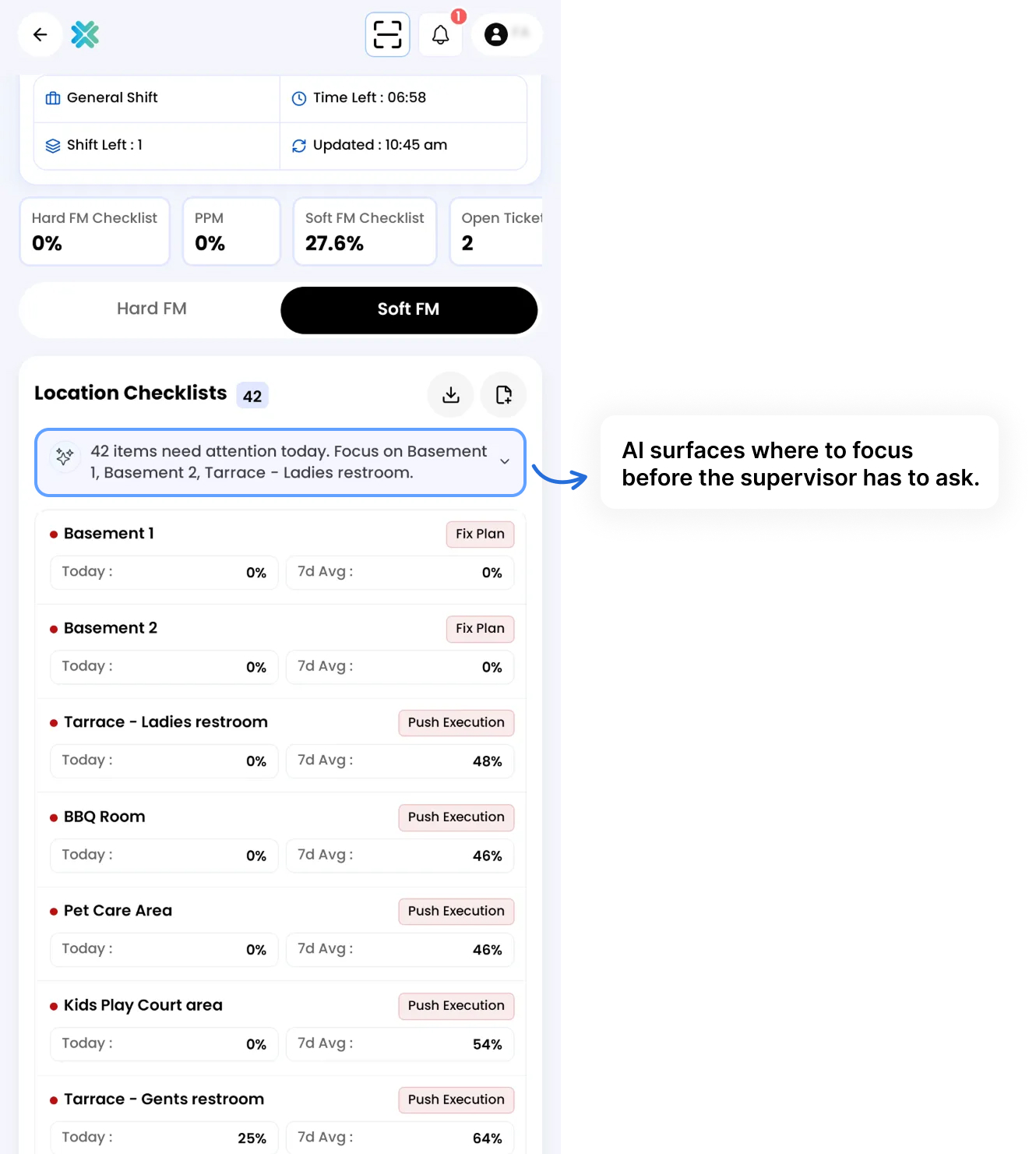
The Supervisor Cockpit changes that. Built for mobile and designed around the rhythms of a shift, it gives supervisors real-time visibility into which spaces need priority attention and how quality assessments are tracking across their team — updated every 15 minutes, not at end of day.
The checklist design is intentionally frictionless. Supervisors complete submissions in the field, not at a desk. Automated quality assessments run on each submission and feed directly into the cockpit view, so supervisors can see — in the moment — where standards are slipping and intervene before the shift ends.
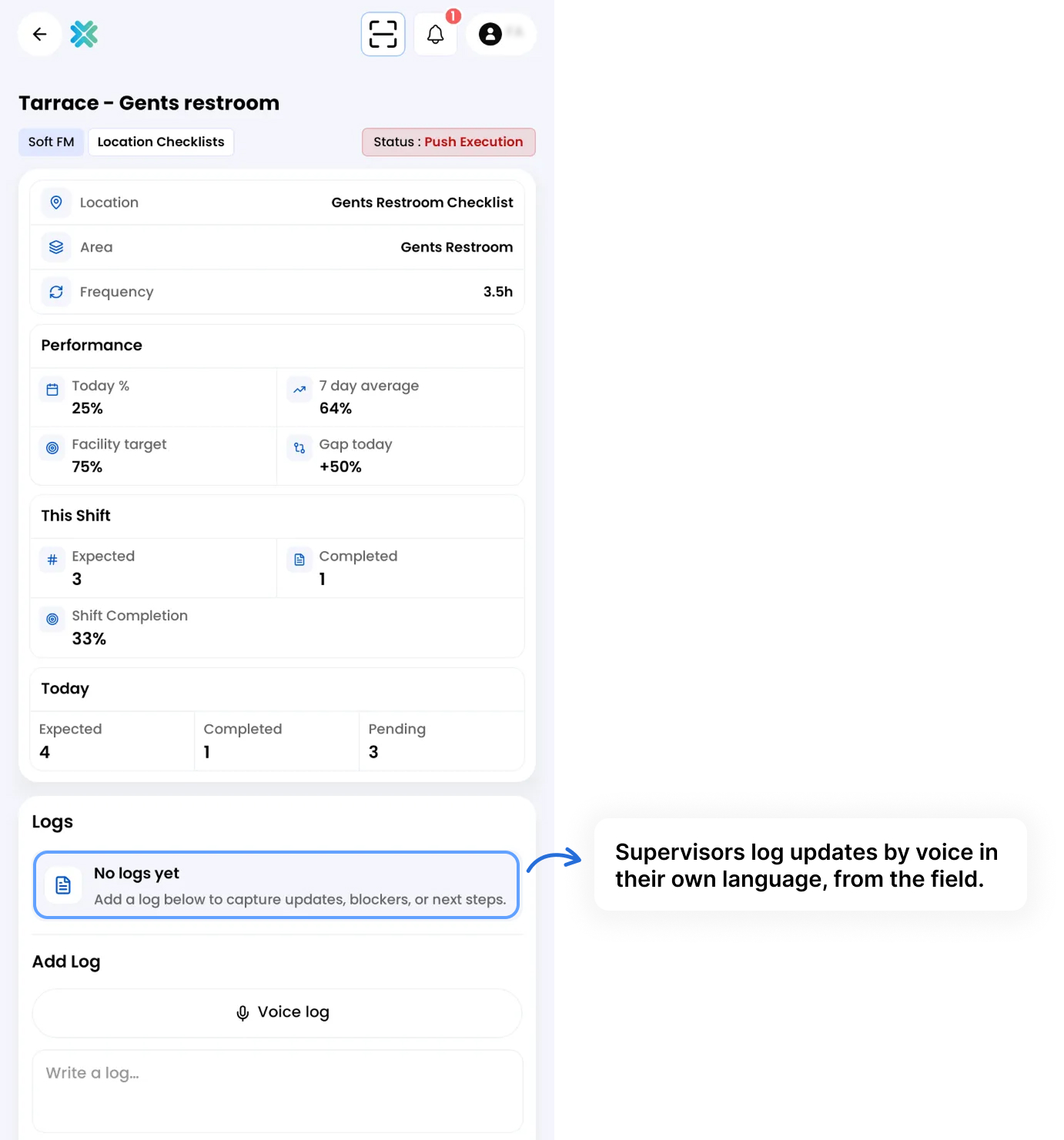
The AI layer surfaces where to focus before the shift falls behind; supervisors tap into any location, see the gap against the target, and log updates by voice in the field.
Outcome Sites operating with the Supervisor Cockpit have seen checklist completion rates improve by 40–50%, with measurable improvements in submission quality over time. Both outcomes are driven by the supervisor, in the field, without any involvement from the corporate office.
The more important shift, though, is structural. Information that would previously have escaped into WhatsApp messages or never been recorded at all now stays inside the system. It becomes part of the organisation's operational knowledge — searchable, auditable, and available to the next person who faces the same issue.
The Facilities Manager Cockpit
Leading and lagging signals, not a dashboard of everything
The Facilities Manager Cockpit sits above the Supervisor Cockpit and is built on the same principles. Everything the supervisor team is doing surfaces upward — but contextually, not as a data dump.
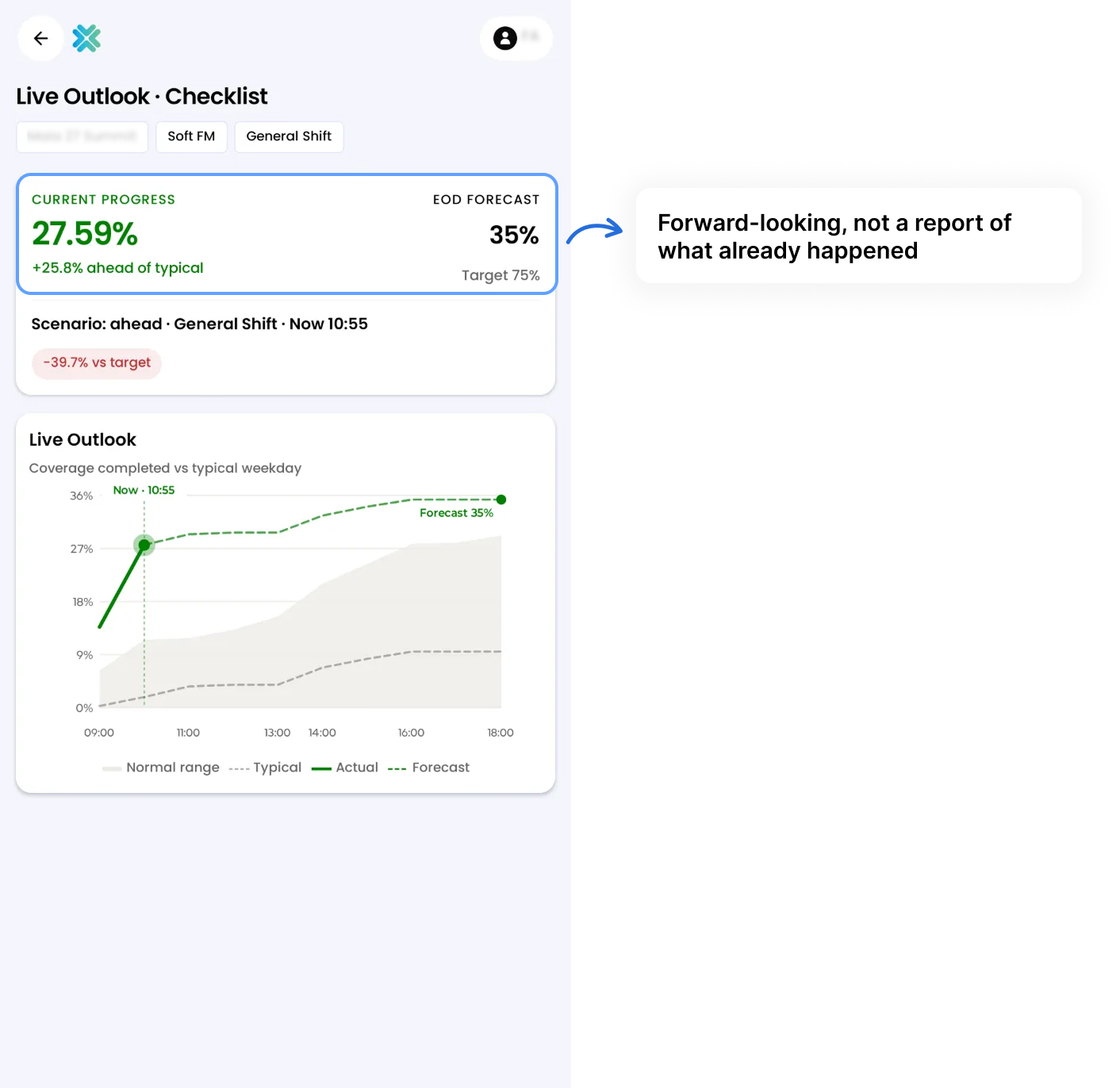
The core question the FM Cockpit answers is: at any given moment, what is my forecast for end-of-day compliance across planned maintenance, soft services checklists, and SLA commitments? Not what happened yesterday. Not what the CMMS says the backlog is. What is the trajectory right now, and where does it need intervention?
The cockpit shows both leading signals — early indicators of where compliance is heading — and lagging signals — what has already resolved or deteriorated. Facilities managers can see quality assessments rolling in from the supervisor layer, track completion rates in real time, and act on the gap before it becomes a missed SLA.
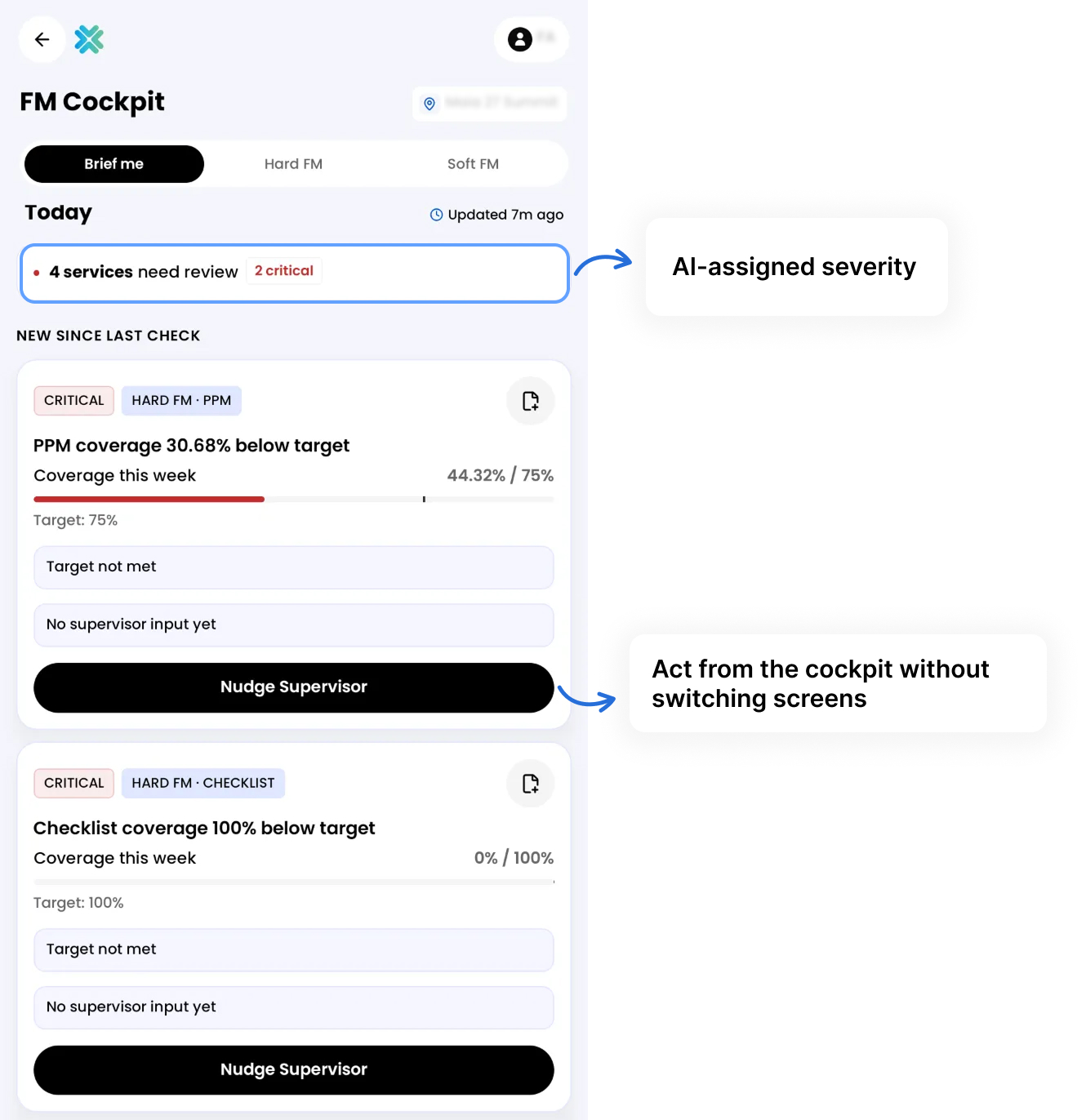
Critical gaps surface the moment the Facilities Manager opens the cockpit with an end-of-shift forecast so they know whether targets will be met before the shift ends.
Design Principal No dashboards. The FM Cockpit surfaces what needs to be done and assists in doing it — not a wall of metrics for the FM to interpret alone.
The structural benefit is the same as at the supervisor level: operational decisions that previously required back-and-forth with the corporate office or portfolio manager now happen at the FM level, within the platform, with the context already attached.
Escalation Layer & Reporting Framework
Closing the loop on SLAs and stakeholder transparency
Two supporting capabilities shipped alongside the cockpits that are worth naming explicitly, because they address the gaps that typically undermine FM accountability.
Escalation Layer
When SLAs are at risk, the system triggers structured escalation notifications — not email threads, not manual chases. The escalation is configured by the FM team, carries full operational context, and routes to the right person. This replaces the informal escalation patterns (WhatsApp, phone calls, chasing supervisors) that currently carry too much of the load in most FM operations.
Reporting Framework
FM companies have always produced reports for end clients — but the process of producing them is largely manual, time-consuming, and inconsistent. The reporting framework allows teams to configure templates, set delivery frequency, and define recipients. Reports go out automatically, carrying the operational data that matters to the client, without a head of operations spending a day pulling it together.
For FM companies managing client relationships, this is a material improvement in how transparency gets delivered — and in the credibility of the data behind it.
Voice & Image AI for Ticketing and Condition Assessments
Reducing the friction of operational data capture
One of the persistent problems in FM operations is the quality and completeness of data at the point of capture. Work orders get raised with minimal description. Inspections are filed without supporting evidence. Condition assessments rely on whoever happened to be on shift that day.
April and May embedded voice and image AI directly into the ticketing and condition assessment workflows. Field staff can now raise tickets using voice — describing the issue as they see it, in their own language — with Sarvam AI handling multilingual transcription for India-based operations. Images captured at the point of inspection feed into automated condition assessments, adding visual evidence to operational records that previously carried none.
Why this matters Better data at the point of capture means better signals feeding the cockpit layer above it. The governance layer is only as good as the operational data it draws on. Voice and image AI address the capture problem at source.
Agent Omi to Supervisor Handover
Human supervisory effort focused where it actually belongs
This was the most significant release of the period — and arguably the clearest expression of what autonomous maintenance looks like in operational practice.
Until now, the ROC (Remote Operations Centre) model still required human supervisors to review a broad sweep of cases — the backlog of assessments, triage decisions, and intervention recommendations that Omi generates across a facility. Much of that review was confirming what the agent had already got right. The handover release changes that dynamic entirely.
The handover protocol works on a straightforward principle: Agent Omi completes its assessment and flags only the cases where it has identified gaps in its own confidence — situations where human review adds genuine value. Everything else is resolved within the agent layer. The supervisor's role shifts from reviewing everything to validating exceptions and marking norms.
In Practice
Here is what that looks like in a live deployment.
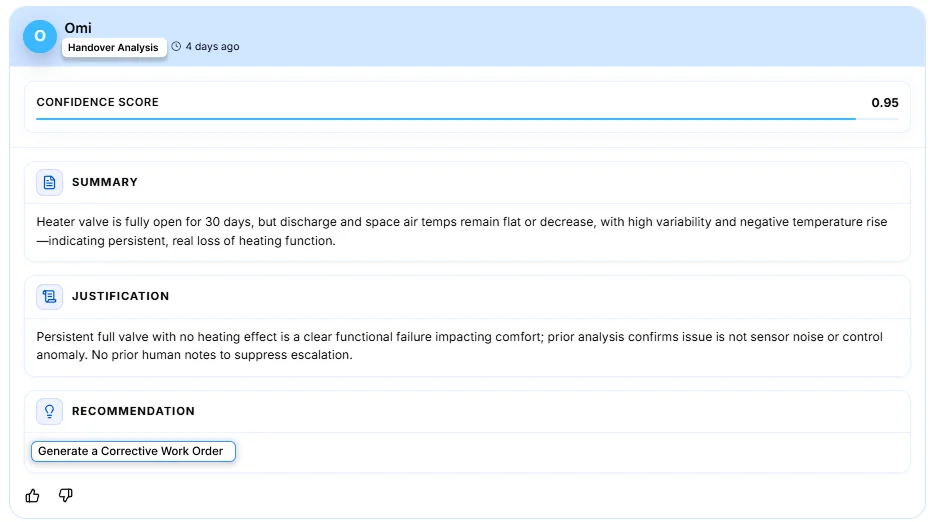
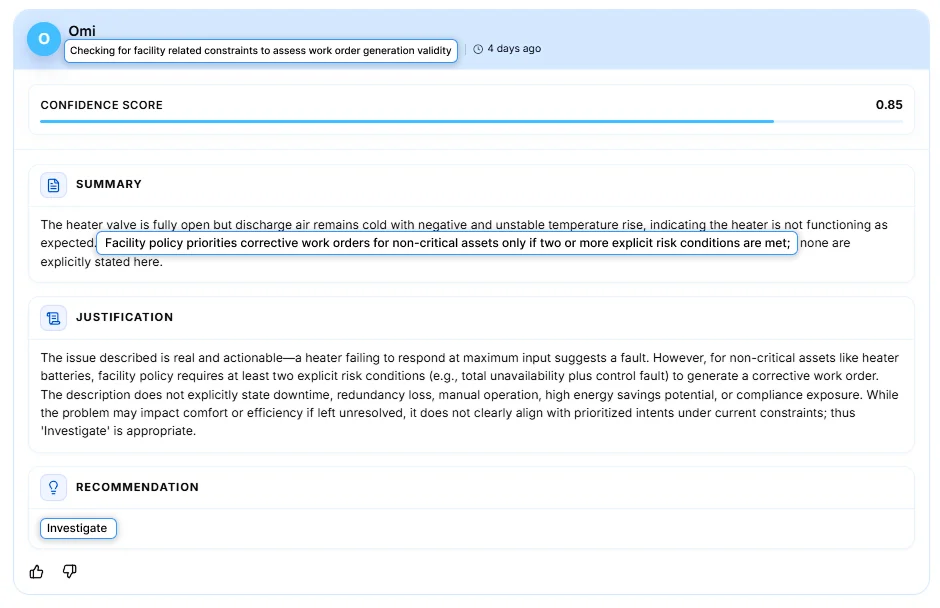
A heater battery was flagged for continuous peak operation over 30 days. Omi analyzed historical trends and confirmed the fault was real. The asset was underperforming despite maximum heating demand. It then checked the facility's maintenance policies and work order criteria. The conditions for escalation were not met. So Omi recommended investigation, not a work order. A call that would previously have required a supervisor to manually triage the alert, review the data, and decide against escalation. Completed autonomously, with full reasoning attached.
Omi confirmed the fault was real and the corrective work order was warranted technically. It then checked the facility's maintenance policy. The conditions for escalation were not met. Recommendation: Investigate. No human intervention required.
The outcome in numbers 60–65% reduction in human supervisory capacity previously blocked by routine triage. ROC teams operating on Xempla now take 1/8 to 1/10 the time to triage and reach a decision compared to a standard platform. On top of that, triage quality has improved 2–3x — because human attention is concentrated on the cases that genuinely require it.
The framing matters as much as the numbers. This is not a productivity improvement bolted onto an existing workflow. It is a fundamental restructuring of what human supervisors are for. In a large-scale integrated FM environment — where a single ROC team may be supervising operations across dozens of sites — this capacity release directly translates to coverage, response quality, and the ability to absorb growth without proportional headcount increase.
Across our integrated FM deployments, the cockpit layer and the Omi handover compound each other: compliance rates up 40–50% at sites running the Supervisor Cockpit, and a 60–65% reduction in supervisory overhead through the handover protocol. These are not independent gains.
This release also marks a meaningful milestone in the DIIV cycle. Discover, Investigate, Implement, Verify — the handover is Xempla's most complete implementation of the Verify stage to date. Omi does not just recommend. It completes, assesses its own output, identifies where it falls short, and escalates with precision. Human verification happens at the point of genuine uncertainty, not as a default layer across everything.
Core Principal Until someone needs to pick up a wrench and go to the asset, most of what happens in an FM operation should be automated or require minimal human supervision. Human expertise should focus on exceptions, not norms. The Omi handover is that principle made operational.
IN PROGRESS — WORK STREAMS & ENGINEERING COCKPIT
Work Streams
Structured automation for non-periodic operational tasks
Planned preventive maintenance runs on schedules. But a significant part of what facilities teams do does not — condition assessments of ageing assets, audits triggered by an incident, inspections ahead of a lease renewal. These tasks currently live in spreadsheets, email chains, or individual memory.
Work Streams is Xempla's capability for structuring and automating these non-periodic workflows. A facilities team can configure a work stream — define the task, the triggers, the data to be captured, and the workflow for acting on what comes back — and the system handles the rest. Voice-guided execution in the field means the UX stays simple even when the underlying workflow is complex.
The first use case in production is the PV solar audit flow, built for a utility-scale solar O&M operator. Field technicians complete structured inspections across solar assets using a guided voice flow — reducing the complexity of form-based data capture and improving the consistency of what gets recorded.
Solar O&M — proof point 2.5 MW of avoided generation loss across a utility-scale solar portfolio. Work Streams is the operational layer that supports that kind of outcome — structured, repeatable, and auditable.
The Engineering Cockpit
Hard FM and energy governance — the next governance layer
The Supervisor and FM Cockpits address Soft FM and the day-to-day operational layer. The Engineering Cockpit is the equivalent for Hard FM — planned maintenance, reliability, energy, and sustainability performance — with the added complexity of BMS integration and asset-level data.
The design principle is identical: surface what the Head of Engineering or Estates Manager needs to act on, not everything the system knows. Opportunities from reliability, energy, and sustainability signals should be visible in a single view, actionable within the platform, and escalatable to contractors or internal teams without leaving the system.
With BMS data feeding in, the Engineering Cockpit closes the loop that most facilities management platforms leave open: the connection between what the building is telling you and what the engineering team does about it.
This closes the full operational stack — Soft FM at the supervisor and FM level, Hard FM and energy at the engineering level, and a portfolio governance view sitting above both.
COMING — PORTFOLIO GOVERNANCE LAYER
Governance Layer
Portfolio-level oversight without the noise
The cockpit stack — Supervisor, FM, Engineering — generates a significant amount of operational signal. The governance layer is what allows portfolio managers and senior leaders to engage with that signal without being buried in it.
The question the governance layer answers is different from the question the FM Cockpit answers. An FM is asking: what do I need to do today? A portfolio manager is asking: where do I need to get involved, and where can I trust the team to operate without me?
The governance layer surfaces those moments — the escalations, the systemic patterns, the sites where leading signals are pointing toward problems that the FM layer has not yet resolved. It is designed for the leader who needs assurance across a portfolio, not operational control over individual sites.
The same principle runs through every layer of the stack: no dashboards. Surface what is important, indicate what needs to be done, and assist in doing it. The governance layer applies that principle at the portfolio level.
The Bigger Picture
April and May completed the first full version of the operational cockpit stack. Supervisors have mobile tools that capture quality at the point of work. Facilities managers have governance tools that surface compliance trajectory in real time. The reporting framework connects that operational clarity to client-facing transparency. Voice and image AI reduce the cost of data capture in the field.
The Engineering Cockpit and portfolio governance layer extend that stack into Hard FM, energy, and senior leadership — completing the loop across every layer of a facilities operation.
This is what an AI-native operating model looks like in practice. Not AI added onto existing workflows, but workflows designed around AI-surfaced decisions, human governance, and institutional knowledge that compounds over time.
Our thesis Facilities teams don't need more data. They need decisions that are already halfway made — surfaced at the right moment, with the right context, to the person who can act on them. That is what we are building.