A signed handover records that an installation has been declared complete. By itself, it does not establish that every required condition has been met. An asset can be physically installed and working while approvals, certificates, monitoring or equipment records are still outstanding.
In one handover we assessed, a score of 93.3% still resulted in a fail because one mandatory requirement remained unresolved. The reason matters: a high overall score does not override a requirement that must be met.
Why those requirements matter
These can look like paperwork, but each one has a job. Required approvals establish whether the relevant authorisations are in place. Electrical certification relates to safety and compliance. Monitoring helps teams identify faults and underperformance that might otherwise go unnoticed. Accurate equipment records support maintenance and warranty claims.
When requirements like these stay open, the effects reach operations in different ways. An outstanding approval can delay the next stage of an installation. Missing monitoring can leave teams without the visibility they need to identify faults or underperformance, while incomplete equipment records can make maintenance and warranty follow-up harder. Unless the requirements are checked, a signature can mark the end of the work without confirming the installation is what it was supposed to be.
Where installations fall short
Australia’s Clean Energy Regulator inspects solar battery installations under the Small-scale Renewable Energy Scheme. As of 30 June 2026, it had conducted 3,425 inspections. Of those installations, 62.28% were rated substandard and 0.76% unsafe. Substandard means at least one clause of a standard or guideline was not met while the system remained safe to operate, and the regulator reports that the issues came from installation practices and workmanship, not the batteries themselves.
The regulator describes these as early results, so they show what can be missed rather than how often it happens. For asset owners, that raises a practical question: how to find such gaps before a handover is accepted, instead of after.
What we see at one site
That is why Xempla’s Handover includes an installation quality check. It tests an installation against the requirements it was meant to meet, once the installer reports the work as done and before the company accepts it.
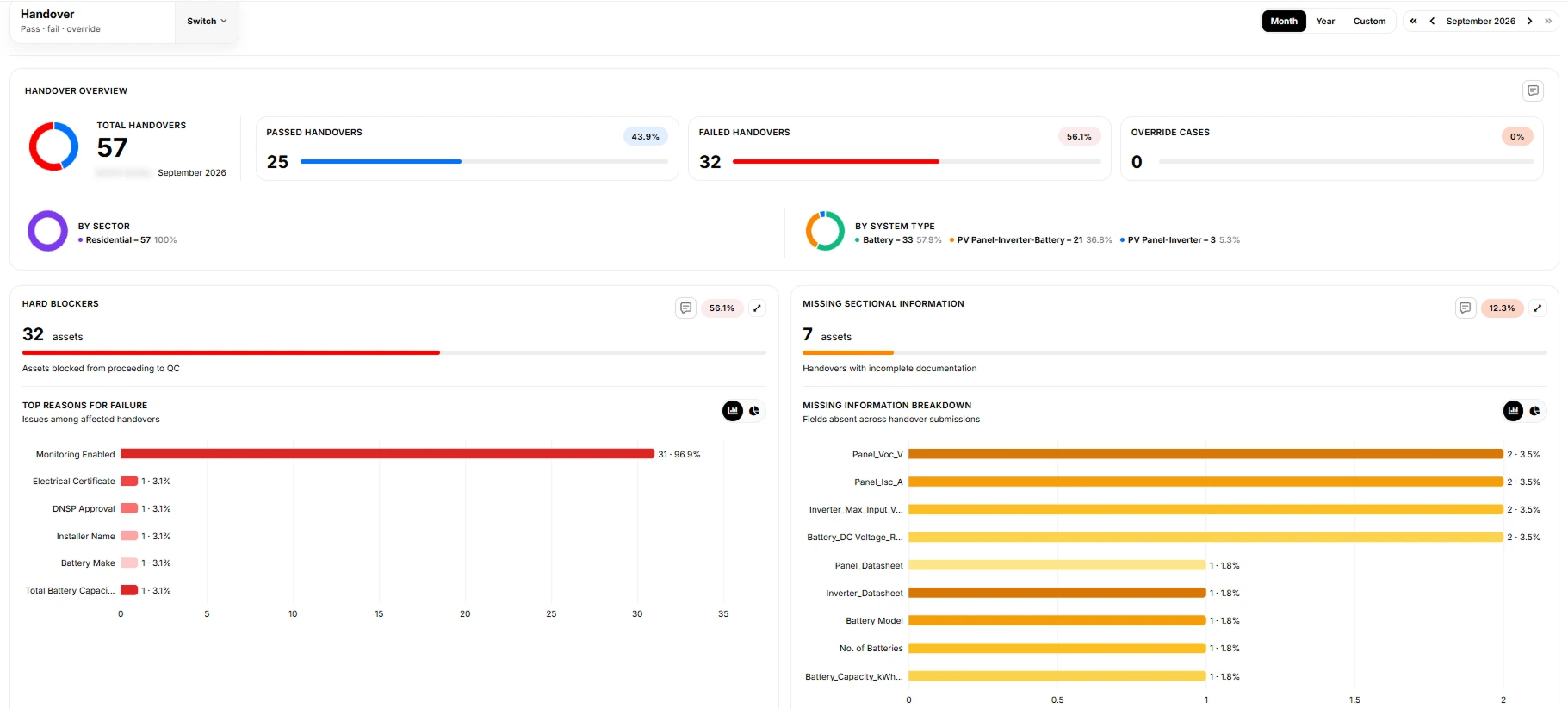
At one site in Australia, Xempla’s live dashboard shows 57 handovers that have gone through the check. Of these, 25 have passed and 32 have not yet passed. Reasons logged include monitoring not being enabled, a missing electrical certificate, an outstanding network approval, and gaps in installer and battery details. On this site’s dashboard, monitoring is the most frequently logged reason for a handover not yet passing. Some of these items are still being worked through.
Why it matters when the gap is found
A gap found at handover is a fix. The same gap found months later is a project. Closing a gap later can mean chasing an approval, locating missing documents, contacting the installer or arranging another site visit. Teams may also need to establish what remains unresolved and who owns the next action. The same pattern appears in maintenance, where a closed work order can still lead to another visit.
How Xempla’s installation quality check works
Step 1: The installation is completed. The company appoints a third party to install the asset, following a set of guidelines and requirements. When the installer reports the work done, the handover begins.
Step 2: Xempla checks the installation. Xempla assesses the handover against each requirement, scores it and flags what is missing. Mandatory requirements are classed as hard blockers. An unresolved hard blocker prevents the handover from passing.
Handover dashboard at one site: 25 passed, 32 not yet passed
Step 3: Gaps are reported. If something is missing, Xempla generates a report showing exactly what. The company follows up with the installer to resolve the outstanding items.
Step 4: The check is repeated. Once the outstanding items have been addressed, Xempla reassesses the handover against the requirements.
Step 5: The company inspects on site. Once it passes, the company’s own team visits the site and inspects it in person, using the Xempla app to capture and file evidence. [Screenshot: app] Passing the check is a step toward acceptance, not acceptance itself.
Step 6: The handover closes. If the site inspection is clear and the handover requirements are satisfied, the handover can be closed and the asset is ready to move into operation.
A Xempla case: a 93.3% score, but a failed handover
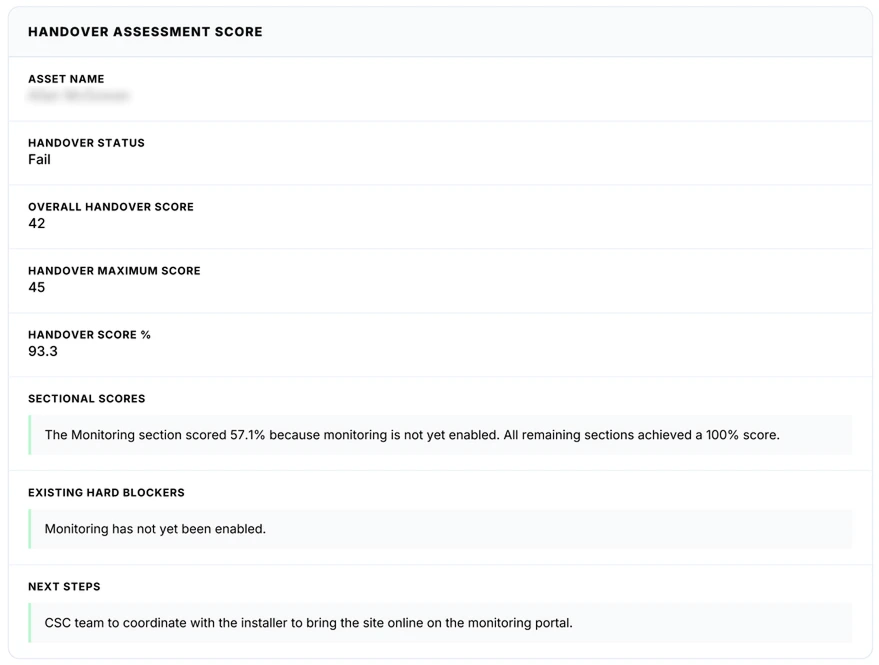
This is the handover from the start of this article. When it was assessed, a battery-system handover scored 42 out of 45 (93.3%), with every section at full marks except monitoring. Monitoring had not been enabled, and because it is a mandatory requirement, the status was Fail.
Handover Assessment Score showing Fail, with monitoring not enabled as the hard blocker
A score of 93.3% reads as nearly complete. The report showed what was missing and set the next step: coordinate with the installer to bring the site online on the monitoring portal.
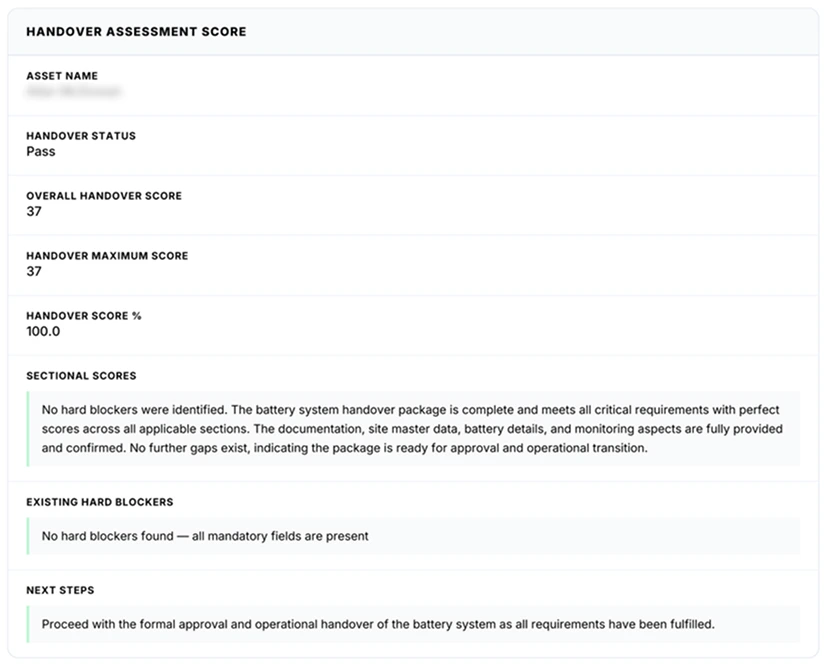
When the handover was assessed again, no hard blockers were found. The report recorded that the documentation, site details, battery details and monitoring had been confirmed, and listed formal approval and operational handover as the next step.
Handover Assessment Score showing Pass, with no hard blockers found
That is the gap the opening described: a handover that looks close to complete can still be missing something it needs. The first report made the monitoring gap explicit; the later assessment recorded no hard blockers and confirmed that monitoring was in place.
Conclusion
Handover is a point at which an organisation can establish whether an installation has met its requirements, and leave a record of what was checked, what was missing and whether it was resolved. For leaders, that record is what turns installation quality from an assumption into something visible.
At Xempla, we build around outcome verification: being able to see whether the defined result was achieved, not just whether the work was done. So, a useful question for leaders is: how many installations signed off this year have been checked against their requirements, and how would you know?
At Xempla, Handover helps teams check installations against their requirements before they are accepted.
An installation quality check verifies an installation against the requirements it was meant to meet. In Xempla it is part of Handover: the requirements are assessed and scored, and anything missing is reported.
When should installation quality be checked?
At handover, once the installer reports the work as done and before the company accepts it. At that point, outstanding items can still be identified and followed up as part of the installation process.
What is a hard blocker in a handover?
A hard blocker is a mandatory requirement. While one is unresolved, the handover does not pass, even if the overall score is high.
What happens if an installation does not pass?
Xempla generates a report identifying the outstanding requirements and the next steps. The company follows up with the installer, and the handover is reassessed after the items have been addressed. A pass is followed by the company’s physical site inspection.