Oops! Something went wrong while submitting the form.
Start the conversation
Tell us briefly about your organisation and what you're trying to understand. We'll come back to you within one business day.
Thank you! Your submission has been received!
Oops! Something went wrong while submitting the form.
No obligation. No sales pitch on the first call. The conversation starts where your questions are.
You Bought AI for Your Buildings. Are You Solving the Right Problem?
Published on :
September 21, 2026
by
Anisha Bhattacharjee
Views...
AI has made it much easier to interact with your buildings. The more interesting question is how much interaction your buildings should need from you in the first place.
You can ask a chatbot about a work order. You can use natural language to find information buried in a system. You can even call an AI helpdesk instead of waiting for someone to answer the phone, but someone still had to place that call. All of that is useful. But there's a bigger question underneath it: what if the operation already has enough context for the system to know what needs to happen, without a person having to initiate anything at all?
That distinction is easy to miss, because making interaction easier feels like making work easier. Sometimes it is. But they're not the same thing. If a person still has to initiate the investigation, find the context, interpret what comes back, and decide what happens next, the interface has improved without changing the work underneath it. The larger opportunity is to reduce how often a person needs to initiate the work in the first place.
What Conversational AI Actually Changes
Facilities software has always required people to learn how it works: which screen, which filter, which report holds the answer. Conversational interfaces remove a lot of that friction, letting someone describe what they need instead of learning the system's structure. The same is true of AI helpdesks and voice assistants. An occupant reporting a problem shouldn't need to understand a ticketing system to do it. That's a genuine improvement, worth recognising on its own terms.
Traditional software requires someone to navigate it. Conversational AI makes that interaction easier. Further along, systems can use the context they already have to assist or act without waiting for a person to trigger every step. A chatbot waits for a question. An agent can work from a goal and the context already available to it, carrying the task forward.
What Is the Difference Between a Chatbot and an AI Agent in Facilities Management?
The difference isn't how natural the conversation feels. It's how much work the system can carry forward without requiring a person to initiate every step. A chatbot responds to an interaction. An agent can work from a goal, available context and defined boundaries to progress a task.
Most of FM isn't a question-and-answer problem. It's a continuous one. Assets change. Conditions change. Priorities change. Work needs to be assessed, progressed and verified. The operation doesn't stop and wait for someone to type a question. So why should technology?
Carrying the Work Forward
This is the principle Xempla is built around, working with the CMMS, BMS and CAFM systems already in place rather than replacing them. The best technology doesn't just make interaction easier. It reduces how much human initiation the work actually requires. The goal isn't to eliminate interaction. It's to eliminate the interaction that exists only because the system can't carry the work any further.
Maintenance makes this tangible. A deviation occurs. The system already has the asset's history and operating context. The question isn't whether it can explain what happened. It's how far it can carry the work before a person genuinely needs to step in.
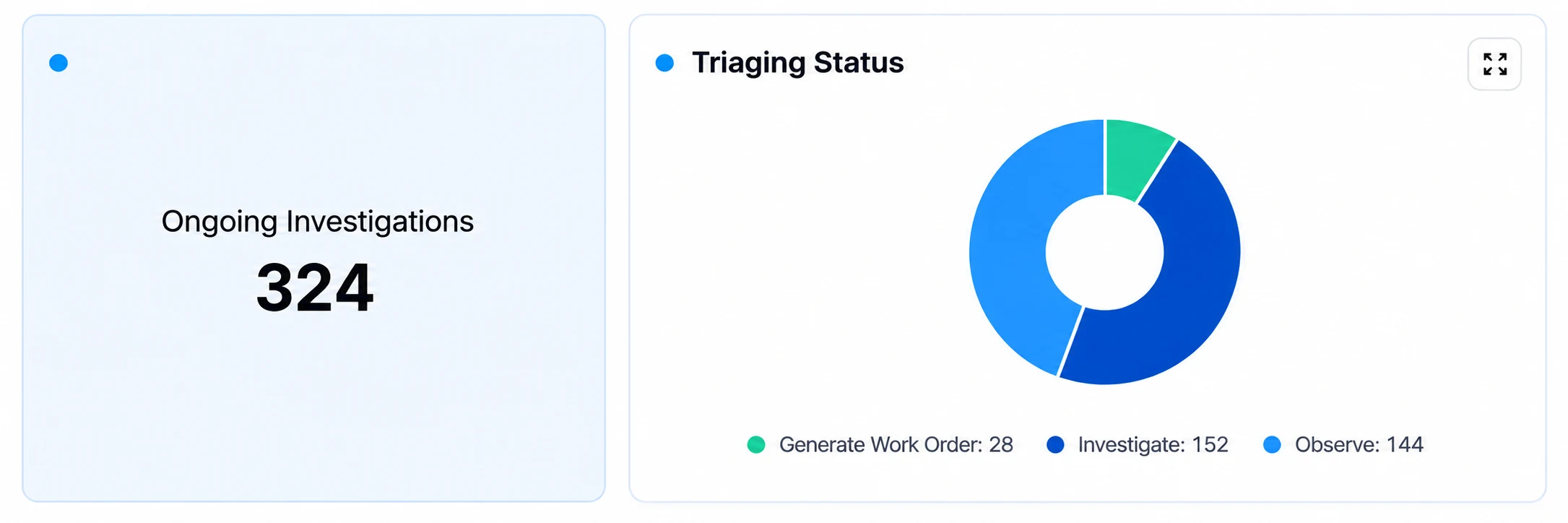
None of this required a person to ask first:324 ongoing investigations, 152 moved to investigate, 144 held at observe, and 28 confident enough to generate a work order
Xempla's reliability agent, Omi, is built around exactly that. Over one year of autonomous maintenance across 25,000 to 30,000 assets, Omi has triaged incoming faults before human review. Of those, 7.5 to 12.5 percent were confident enough for Omi to generate the work order itself, without review. Across everything triaged, only 2 to 3.5 percent ever became a work order at all. What's worth noticing isn't the work order itself. It's what happens before one exists: the system assesses which cases meet its defined criteria and moves those forward on its own, within its boundaries.
Knowing When Not to Act
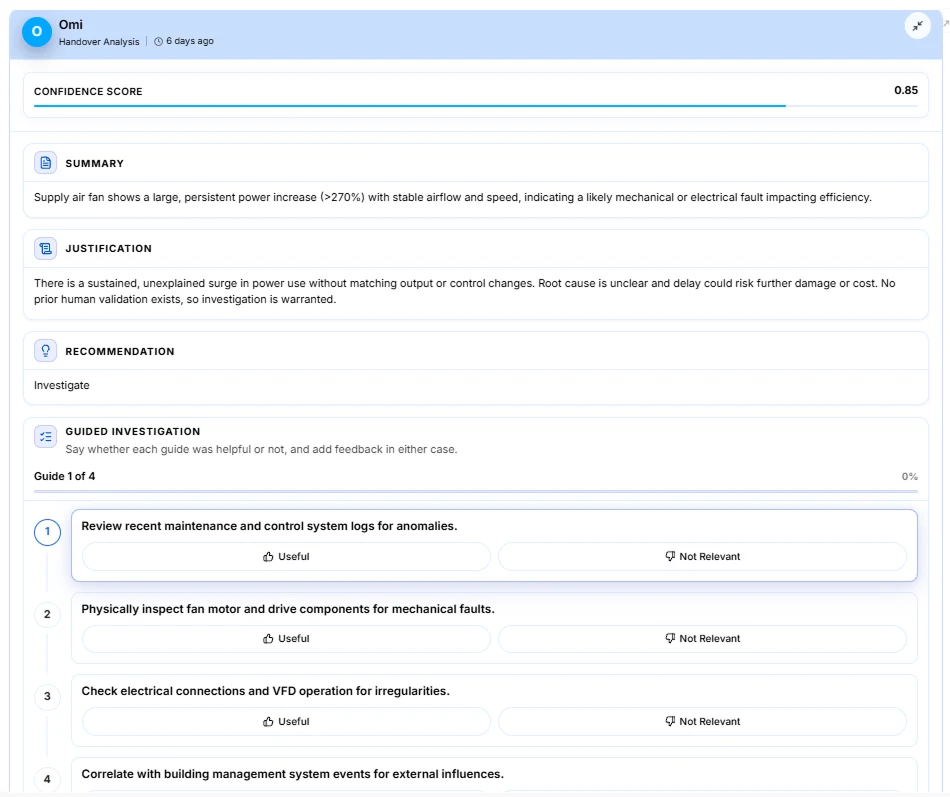
A handover, not a blank slate: the reasoning, the context and the next steps, so judgment picks up exactly where it's needed
Carrying work forward only holds up if the system also knows where to stop. That is the human-in-the-loop principle: when a case falls outside what Omi can resolve with confidence, it doesn't guess, it brings in a person, with the context already gathered, a clear account of what's still unresolved, and the specific next steps that need to be checked. That person doesn't start cold. They start at the point where their judgment is actually needed. The goal was never to remove human judgment. It's to stop spending it on work the system can reliably carry itself.
Before the Work, There's the Picture
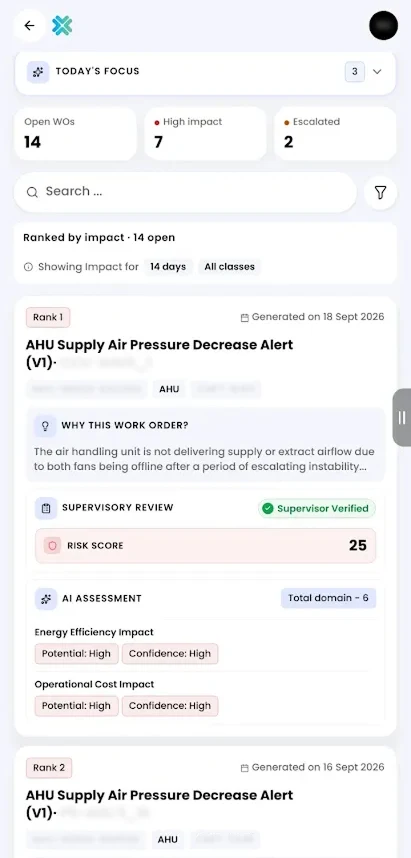
The priority is already surfaced, with the context sitting right behind it. No list to work through, just the picture already sorted
A facility manager, supervisor, or engineer shouldn't have to assemble the operational picture from scattered information just to see what needs doing, and what's relevant to each of them isn't the same picture. The point isn't to give someone another place to monitor. It's to remove the work of finding, filtering and assembling the picture that's actually theirs to act on.
When Asking Is Still the Right Move
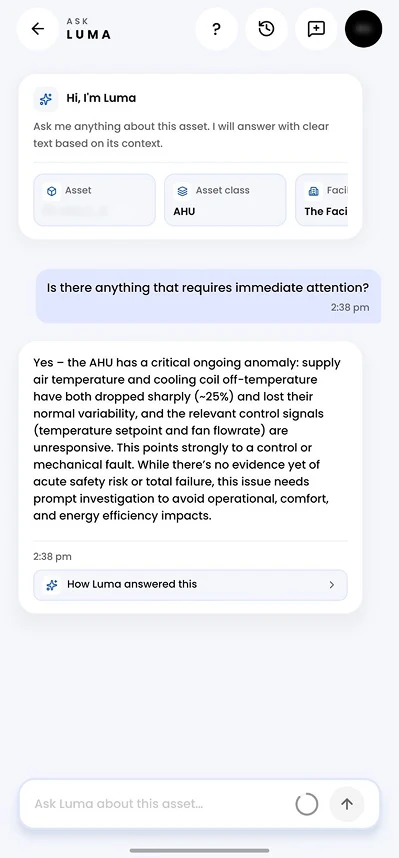
A question that only exists because someone had it: an asset selected, one thing asked, one thing answered
None of this means people should stop asking questions. Some needs only exist once a person raises them: a technician wanting a specific detail about an unfamiliar asset, or a one-off question about a location. That's exactly what Luma Chat is for, Xempla's assistant built into the mobile app. The philosophy was never that interaction should disappear. It's that the system should distinguish between the work that needs a person to initiate it and the work it already has enough context to carry forward on its own.
And Outside the FM Team
Consider the people using the building too. Someone reporting a broken fixture doesn't need a sophisticated AI experience, they need it logged with minimal effort. A QR code and two fields may be all that is needed, simply because it asks for exactly as much as the moment requires, and no more.
What to Actually Look for in AI
This changes the questions worth asking about any AI system in FM. Not just what can I ask it, but what does it already know without being asked. Not just how good are its answers, but how much human initiation it actually removes from the operation, and when a person does step in, are they starting the work or finishing the part that genuinely needed their judgment.
The question for FM leaders isn't how much AI they can add to every interaction. It's how much unnecessary human initiation they can remove from the operation.
Carry the work as far as the system reliably can, until someone actually needs to pick up the wrench.
What is the difference between a chatbot and an AI agent in facilities management?
A chatbot responds when someone asks it something. An agent works from a goal and the operational context already available to it, and can carry a task forward without needing a person to initiate every step. In practice, that's the difference between answering a question about a fault and assessing whether that fault meets defined criteria for action.
How does AI actually reduce the workload on a facilities team?
When a system already has an asset's history and operating context, it can assess what's happening before anyone has to go looking for it. That reduces the initiation, investigation and information-gathering a person would otherwise have to do before they can act on what actually needs attention.
How does an AI agent know when to act on its own and when to bring in a person?
It acts within defined boundaries. When a case doesn't meet the criteria for confident action, the system hands the case to a person along with what's known, what's unresolved, and the specific next step to check. The person starts exactly where their judgment is actually needed.
Does this kind of AI replace the CMMS, CAFM or BMS a facilities team already uses?
No. AI agents can work alongside existing CMMS, CAFM and BMS systems, using the operational data already available in those systems to assess conditions and progress defined workflows. The goal is to add decision and action capabilities around the existing technology stack, not to require a rip-and-replace approach.
What should an asset owner look for when evaluating AI for their buildings?
Three things: what the system already knows without being asked, how far it can carry a task before a person needs to step in, and what the handover contains when human judgment is required. Those three checks get closer to real operational value than the features on a demo call.